

Kolkata, October 2025 — When the floodlights glow over the Maidan and chants echo across the stands, the IFA Shield still carries the same magic it did more than a century ago. As the tournament celebrated its 125th edition this year, its story remains one of pride, passion, and the unbroken legacy of Indian football.
Founded in 1893, the Indian Football Association (IFA) Shield is not just another sporting event—it’s a piece of living history. Older than even the FIFA World Cup, the Shield began as a colonial tournament under British rule, contested by British Army teams and European clubs stationed in India. The Royal Irish Rifles won the inaugural edition, and for nearly two decades, British regiments dominated the trophy, reflecting the social order of the time.


But everything changed in 1911. That year, barefoot Indian footballers from Mohun Bagan Athletic Club scripted history by defeating the mighty East Yorkshire Regiment 2–1 in the final. It was more than a sporting triumph—it was a national awakening. For the first time, Indians had outplayed their colonial rulers on the field. The victory resonated across the country, earning Mohun Bagan the immortal title of “Immortal Eleven.” The 1911 IFA Shield became a symbol of freedom, courage, and self-belief during the pre-Independence era.
As India moved into the post-colonial decades, the Shield became the stage where legends were born. Clubs like East Bengal and Mohun Bagan turned the tournament into a footballing battlefield that captured the city’s imagination. The rivalry between the red-and-gold and the green-and-maroon gave rise to the famed Kolkata Derby, transforming every final into a festival.


The 1940s and 1950s saw East Bengal emerging as a powerhouse, clinching multiple titles and establishing an unmatched dominance. Their victory in 1943 marked the beginning of an era that would see them lifting the IFA Shield a record 29 times—a feat that still stands today. The club’s 1973 triumph against Pyongyang City of North Korea remains one of the tournament’s most memorable international clashes, symbolizing India’s growing footballing stature on the Asian stage.
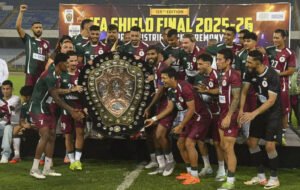

Mohun Bagan, on the other hand, has always carried the weight of history and emotion. Their consistent performances through the decades—especially in the late 1970s when they won four consecutive Shields—cemented their reputation as one of Asia’s oldest and most decorated clubs. The Mariners’ latest victory in 2025, coinciding with the 125th edition, serves as a poetic reminder of their everlasting influence in Indian football.


While the Kolkata giants have traditionally ruled the Shield, the recent decades have welcomed new challengers. The rise of Real Kashmir FC, who lifted the trophy in 2020 and 2021, marked a refreshing chapter in the competition’s evolution. Their victory from the snow-capped valleys of Kashmir reflected the spread of football’s passion far beyond Bengal, proving that the spirit of the IFA Shield now belongs to the entire nation.
Over the years, the tournament has evolved in format and scope. Between 2015 and 2018, it turned into a youth competition to nurture future talents, before returning to senior-level contests in 2020. Yet, despite these changes, its emotional core remains untouched. The Shield continues to inspire players and fans alike, serving as a bridge between the sport’s colonial past and its vibrant present.
From barefoot heroes to foreign signings, from army teams to professional clubs, the IFA Shield has witnessed the transformation of Indian football. It has carried the dreams of generations—each goal, each cheer, echoing through more than 130 years of heritage.
As Indian football now looks toward global leagues and new investments, the IFA Shield stands as a reminder of where it all began. It is not merely a trophy—it is tradition, emotion, and history wrapped into one silver cup. The glory of the Shield is timeless, and its story continues to inspire a nation that still dreams through the beautiful game.