What was meant to be a historic celebration of football in Kolkata spiralled into chaos on Saturday as thousands of fans vented their anger at Salt Lake Stadium following Lionel Messi’s fleeting appearance in the city. The Argentine superstar’s visit, part of his much-hyped “GOAT Tour,” ended in disappointment, vandalism and a political storm, raising serious questions about event management, administrative accountability and crowd safety.
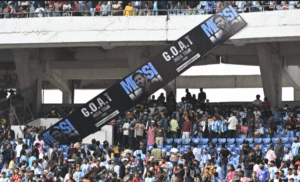
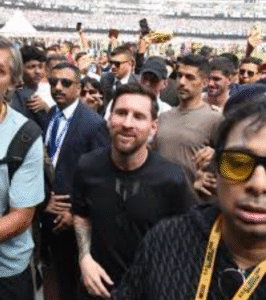
Nearly 80,000 football enthusiasts had gathered at the iconic stadium, many paying as much as ₹14,000 per ticket, in the hope of witnessing even a brief moment of the global football icon. Instead, Messi remained inside a tight security cordon, interacting only with politicians, dignitaries and select VIPs before leaving the venue within 15 minutes. For the vast majority of fans, there was no glimpse, no wave, and no acknowledgment.
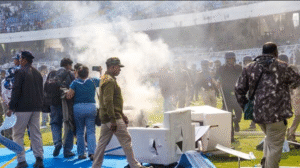
The sense of betrayal was palpable. As Messi was escorted out, frustrated spectators began booing officials and demanding answers. Chairs were uprooted, plastic bottles hurled, and sections of the stadium infrastructure vandalised. Security arrangements quickly collapsed as sections of the crowd surged towards the field, forcing police to summon anti-riot forces to regain control.
Messi, who had arrived in Kolkata earlier in the day and unveiled a statue as part of his itinerary, was hurriedly taken away from the stadium and later departed for Hyderabad, his next stop in India. By then, Salt Lake Stadium resembled a battleground, with organisers and law enforcement struggling to contain the fallout.
As tempers flared on the ground, the political temperature soared off it. With assembly elections looming, the incident proved deeply embarrassing for the West Bengal government. The oppositions launched a scathing attack, branding the episode a “global humiliation” and accusing the state administration of gross mismanagement. Senior BJP leaders claimed the fiasco reflected the government’s inability to handle large-scale international events.
Chief Minister Mamata Banerjee responded by issuing a public apology to both Messi and his fans, stating she was “shocked” by the lapses in planning and execution. An inquiry committee headed by retired judge Ashim Kumar Ray was constituted to identify those responsible. The Trinamool Congress also distanced itself from the organisers, with party leaders openly questioning how such an event was allowed to proceed without ensuring visibility and crowd engagement for paying spectators.
“Kolkata was shamed,” remarked a senior Trinamool leader, echoing the mood of a city known for its deep-rooted football culture. “The anger of the fans is justified.”
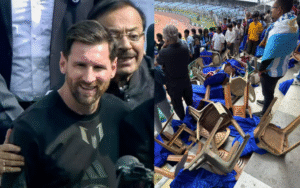
Governor C V Ananda Bose described the episode as a “dark day for sports-loving Kolkata” and issued a series of directives, including the arrest of the event organiser, a judicial probe, and immediate refund of ticket money. Shortly after, an FIR was registered against the main organiser, Shatadru Dutta, who was taken into custody.
While arrests and inquiries followed swiftly, a larger question remains unanswered. Maintaining law and order is undeniably the responsibility of the state administration. But where does the accountability of an event management company begin and end? When private organisers profit from massive ticket sales, do they not share equal responsibility for planning visibility, crowd control and safety?
The Salt Lake Stadium chaos has exposed a troubling gap between spectacle and substance. For thousands of fans, a dream dissolved into disillusionment. For Kolkata, a city that prides itself on football passion, the incident has left an uncomfortable scar — and a pressing demand for answers, accountability and reform before the next grand event promises more than it can deliver.